

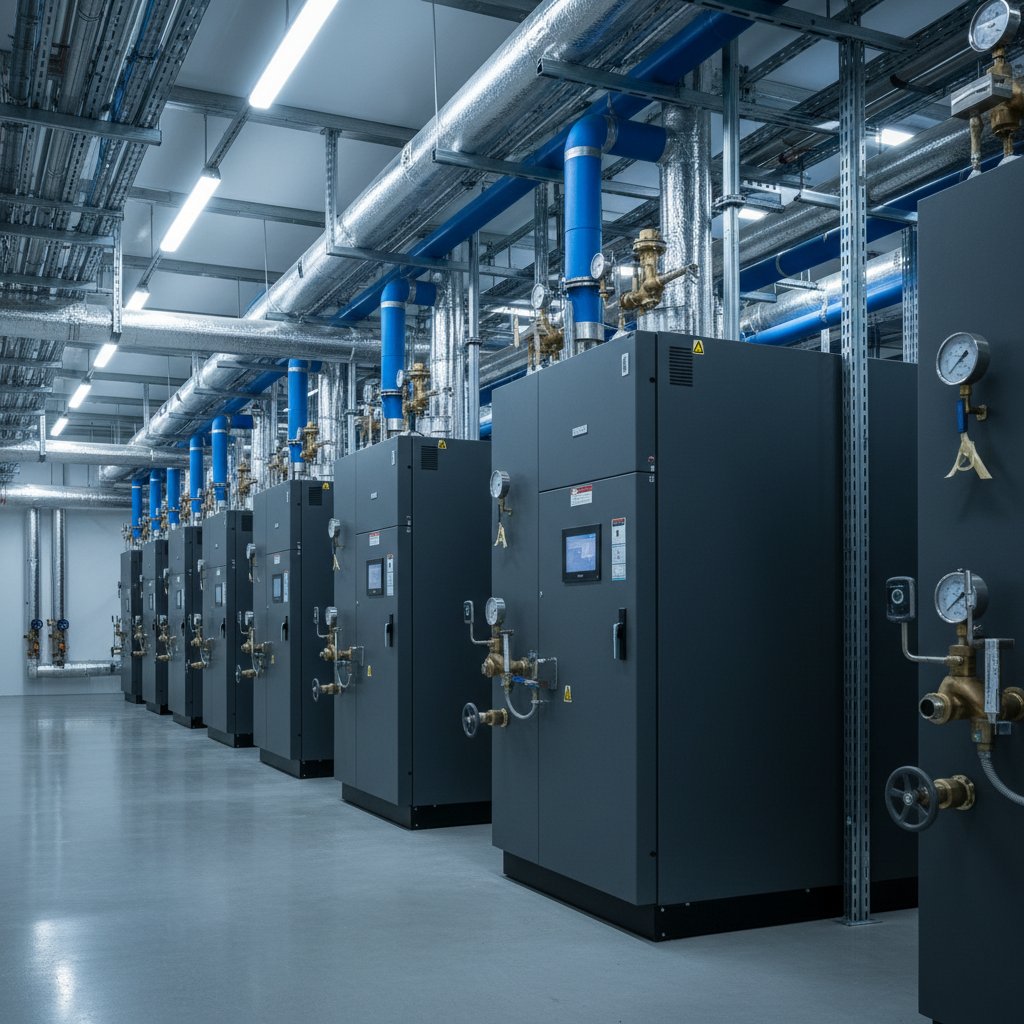
Datacenter HVAC is not building HVAC with more capacity. A building system keeps people comfortable across a slow, forgiving thermal cycle. A datacenter system removes a constant, concentrated heat load from equipment that will throttle or fail within minutes if it stops.
Why datacenter HVAC is different
Three differences drive everything else.
The load is constant and concentrated. An office is warm in the afternoon and empty at night. A datacenter produces the same intense heat at 4am on a Sunday, in one dense area rather than spread across a floor.
The tolerance for failure is minutes. If office cooling fails, people get uncomfortable. If datacenter cooling fails, a dense hall can reach damaging temperatures very quickly, and the equipment protects itself by throttling or shutting down.
The airflow is directional. Servers pull air in the front and push it out the back. The system’s entire job is to deliver cold air to the front and take hot air away from the back without the two ever mixing. Room comfort is irrelevant.
Airflow management comes first
Before adding any capacity, fix the air. In our experience most halls that feel short of cooling are short of airflow discipline instead.
- Hot and cold aisle layout, so racks face each other correctly
- Containment on one aisle or the other, so supply and return cannot mix
- Blanking panels in every unused rack unit
- Brush strips and grommets on all floor and cable cutouts
- Vented tiles only in the cold aisle, and only where needed
- Rear cable management that does not choke the exhaust
These measures cost very little and routinely recover capacity that owners were about to spend six figures on plant to replace.
Humidity: the forgotten half
Too dry and static discharge becomes a genuine risk to hardware during handling. Too humid and you risk condensation and corrosion, particularly on cooling coils and where cold surfaces meet warm air.
The traditional obsession with tight humidity control has softened as equipment tolerance improved, but the extremes still matter. What causes more trouble in practice is units fighting each other: one CRAC humidifying while its neighbour dehumidifies, burning energy to achieve nothing. Controls should be coordinated across units, not left to argue.
Redundancy: N, N+1 and 2N
Redundancy language is simple once written down. N means exactly enough capacity to carry the load, with nothing spare. N+1 means one extra unit beyond what the load requires, so one failure or one maintenance window does not reduce cooling. 2N means a fully duplicated system.
N is not a design, it is a hope. The moment one unit fails or needs a filter change, you are under-cooled. N+1 is the practical minimum for anything that matters, and it is what lets you maintain the system without negotiating an outage.
Efficiency and PUE
PUE (Power Usage Effectiveness) is total facility power divided by IT power. A PUE of 2.0 means you burn a watt of overhead for every watt of compute. Modern well run facilities achieve well below 1.5, and cooling is the biggest lever.
The efficiency wins, in order of value for money: containment first, then raising supply temperature within the ASHRAE envelope, then free cooling where the climate allows, then variable speed fans and pumps. Northern European climates are generous for free cooling and it is frequently under-exploited.
The mistakes we see most
Cooling by room temperature rather than intake temperature, which leads to over-cooling the whole hall to satisfy one badly placed sensor.
Buying capacity to solve an airflow problem, which is expensive and does not fix the hot spot.
No containment, quietly halving the effective capacity of an otherwise decent system.
Filling a rack to its U capacity with no blanking, guaranteeing recirculation.
Ignoring the residual air load in liquid cooled racks: cold plates capture 70 to 80 percent of the heat, and the rest still leaves as air.
Treating datacenter cooling as a building services line item, and handing it to a contractor who has never commissioned a hall.
Frequently asked questions
Is datacenter HVAC different from normal HVAC?
Yes, fundamentally. Datacenter HVAC removes a constant, concentrated equipment load with a directional front to back airflow and a failure tolerance measured in minutes. Building HVAC manages human comfort over a slow, forgiving cycle.
What is PUE?
Power Usage Effectiveness: total facility power divided by IT power. A PUE of 2.0 means one watt of overhead per watt of compute. Modern efficient facilities run well below 1.5, and cooling is the largest single lever.
What humidity should a datacenter run at?
Avoid the extremes rather than chasing a narrow band. Too dry raises static discharge risk during handling; too humid risks condensation and corrosion. The bigger practical problem is uncoordinated units humidifying and dehumidifying against each other.
What does N+1 redundancy mean for cooling?
N is exactly enough cooling for the load with nothing spare. N+1 provides one unit more than required, so a failure or a maintenance window does not leave you under-cooled. N+1 is the practical minimum for critical environments.
Can I improve cooling without buying more units?
Usually yes. Containment, blanking panels, sealing floor cutouts and correcting vented tile placement typically recover significant capacity, and cost a fraction of new plant. Fix airflow before buying capacity.
Do liquid cooled racks still need air cooling?
Yes. Direct-to-chip cold plates typically capture 70 to 80 percent of the rack’s heat. The remainder still leaves the rack as air and must be handled by the air cooling system.
Read next: our datacenter cooling guide and guide to CDUs. For installation, see datacenter cooling and HVAC or request a site survey.